Showing posts with label STP4. Show all posts

Wednesday, 28 August 2019

Cheryl Torrie- Blinging Blogs with Images


Cheryl Torrie- Blinging Blogs with Images- Teacher Professional Development

Cheryl presented a great slide show that demonstrated how to create collages of photos to embed in our blog posts. These collages could replace the long 'scroll-down' photos of the novice blogger, namely me.

She gave a variety of apps and websites for this purpose.

To demonstrate my fledgling understanding of this I have embedded one of my own collages using random photos (from various Science lessons) that were stored in Google Photos.


Lunapic was one app. that created artistic effects from photos. I have attempted an example of this here with a shot of my siblings and me.


Monday, 26 August 2019

Marc Gibson - T3 - Using flexible learning groups within the curriculum

Marc Gibson -Using Flexible Learning Groups Within the Curriculum


As part of our digital professional learning, Marc Gibson presented the way his school worked with 75 students in a class of 3 teachers. Students worked in flexible groupings that sprang out of the workshops and the roles of teacher as "Taskmaster" and "Coach". Learners select workshops based on their learning needs (taken from the Literacy and Maths Learning Progressions).

The systems within the class were well unpacked with students in term 1 of the year, timetabling was changed each week and a method for students to upload their work to a Learning Progression was established. Students select and sign up to at least 1-2 workshops in each subject area on Monday with the help of a teacher.

Teachers have a different role each week over a three week period.  In Reading the coach works on the end goal  and students work on one task for the whole week, a task that fits with any book. A set of 8 texts is selected each week. Students click on the title to see other complimentary reading and challenging reading related to the book. This meets the requirements for "Multimodal" learning. Students do not work in ability groups although the lower readers do work together but are still part of the book choices for homework etc.

The class site is shared with parents so they can see what the book choices  and tasks.

In writing the students have to complete one piece of writing for the week. During this time the ESOL students leave the room.

In Maths there is a Hotspot activity in the main learning area e.g., fractions. The teachers work in three roles as coach, problem solving and workshops. There is also a Heart zones activity which is more like play based learning. The workshops plug the gaps in the knowledge. Each students has to complete one artefact to show they have learned it. For problem solving teachers work with groups of 18, on 2 problems a week. The students have a specific process to work through.

Each child has their own digital copy of the progressions that are highlighted once they have proven that they have learned it. From these progressions the teachers can target the learning and address the gaps.

So what does this mean for my teaching?

It took much time to set up this school's systems.  They now have a cohesive mode of teaching and learning that meets students' needs, motivates students and raises ability.
Of course this new system needs to be from the top down in a school setting such as ours. School management needs to engage with the process and not see it as a quick fix strategy. It requires commitment over time.

I could...
  • Trial the workshop idea on my class site and have a variety of reading books for the book choice. This would work more for my readers who are achieving at a good standard
  • For my underachievers daily guided reading and mileage is worth continuing and their workshops would be based around their need for decoding and alphabet skills. Their voice needs to be factored in to the planning
  • Process writing would continue along with choices for some different genre or types of grammar. Nothing is new there.
  • Problem solving options help create mixed ability groupings and sound better when students mix themselves for maths through their choices (rather than the predetermined mixed groupings that I have heard other educators talk about)
  • Workshops that plug the gaps in student knowledge also sound worth doing. 
There is only one teacher in my class of 26, so this limits the flexible nature of groupings and options. However, it would be good to include a few of these ideas in the planning  as part of my own inquiry.


Wednesday, 31 July 2019

Professional Development for Educators of Children with Additional Needs (SENCO)

Educators of Children with Additional Needs 

The Hub

Tony Hassan from Learning Support, Kaitaia spoke to the seminar. There has been recent consultation in the Far North around the Ministry of Education's Learning Support Hub and in particular the co-designing of the Learning Support service delivery in Tai Tokerau.  The Hub in the Hokianga Initiative is promoted online with the dates the team of RTLBs and MoE's Learning Support will be visiting the schools of the area. The Hub is made up of  the Ministry of Education agencies such as speech language, oral language help, and early intervention etc. Parents/ whanau can call into the Hub to seek help for their child or attend sessions that assist the child such as speech training. Tony said the rate of new referrals had increased 1400% since the commencement of the Hub. The most referral cases have been for communication. Future additions to the Hub may be the inclusion of health services.

Learning Support Action Plan

Priorities for action
1. Learning Support Co-ordinators
2. Screening and early identification of learning support needs
3. Strengthening early intervention
4. Flexible supports for neurodiverse children and young people
5. Meeting the learning needs of gifted children and young people
6. Improving education for children and young people at risk of disengaging


Mindfulness from an Indigenous Perspective      Joni Gordon

Joni's PHD study hypothesis: Do the spiritual practices of Kura Kaupapa have a mindfulness effect?

Conceptualising Maori mindfulness: the tensions and opportunities when reconciling mindfulness.and kaupapa Moari
Matauranga Maori and Mindfulness
  • Whakapapa-genealogy
  • Nga Atua Maori-The pantheon of Maori godds
  • Spiritual practices: karakia (prayer), tohi , takutaku (chants)
  • Environment
  • Manawa/ Mauri- negotiating their interaction
Influences:
  • European ethnographers
  • Literature, veers towards the male lens
  • Mana wahine-reclamation of ancient wisdom and making space
  • The politics of indignity
Be present
  • Ritual time
  • The collapsing of time into space
  • Time in relation to environment
  • Reading the stars
Mauritau/ Manawaora- how these concepts interact
Reconciling heart and mind

Examples of mindfulness practices:
Deeply considering a taonga.
Deeply reflecting on a poem etc in Maori and English (and sharing what was experienced ) 

Massey University have an online collaborative network, the"Learning Support Network".        Mandia Mentis (Massey)

This website consists of

  • A wealth of resources for the special education teaching community, in particular for SENCos
  • Networking and connecting of SENCos nationwide through calendars of events
  • Live webinar every Thursday evening
  • Online professional development modules to complete for teachers
  • Digital badges can be earned that can cross credit to a short course, a Post Graduate Qualification into Learning Support
  • Helps SENCos integrate their learning into our practice
  • Alignment with the 6 teacher standards
  • Supports SENCo inquiry

So what did today's seminar mean for my role as SENCo?

  • Connect to the Learning Support Network website with one other person in the school
  • Participate in weekly webinars online as often as possible, to gain digital badges towards a Post Graduate in Learning Support
  • Incorporate mindfulness practices into my class (in a way that aligns with who I am) as well as  for high anxiety students
  • Investigate the new Learning Support  Coordinator role and Action Plan.


Wednesday, 24 July 2019

Talk Link Course a Professional Development Course for Special Education Teachers

TalkLink, a Professional Learning Opportunity for Teachers 


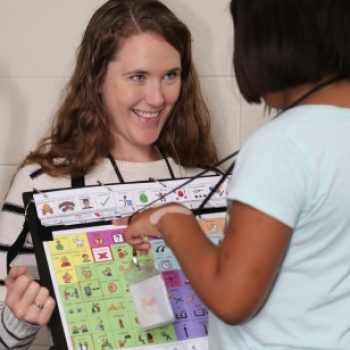
The main topic of this course was the use of the hard copy CORE board and its many possibilities.
Polly Thomas (TalkLink) explained and demonstrated the various ways that the CORE Board could be used with students who are on the Autistic Spectrum, to aid them in communication. By teachers pointing to each image they are able to communicate their directions or requests and at the same time the student is able to communicate visually.

The top of each board has a ring binder with strips of special interest words that are most relevant to the student.  Strips can be changed or added to as the child's level of communication grows.

The mantra of TalkLink for student engagement is to motivate, model and move out of the way!

The communication device can be used to communicate when on playground duty or in the classroom, or when students shut down and are unable to communicate their needs. The teacher is able to wear a 'YES' or 'NO' sign on a lanyard for those types of responses.


People

Sunday, 21 July 2019

Creating High Expectation Classrooms- Christine Rubie-Davies

Creating High Expectation Classrooms           Seminar by Christine Rubie-Davies

This seminar covered a model of teacher expectations where teachers have high expectations, plan for goal setting and mixed ability grouping, establish a positive culture of care (climate) and promote student autonomy. Some of the key findings from her research are included in this post.

Grouping can affect student motivation and learning.
Grouping can affect student motivation. A study for no streaming of Maths students.

Stereotyping can turn into bias where teachers' beliefs about  students become very fixed.
Maori students would like their teachers to be more supportive, caring, have high expectations, and help them to strive for success.

Explicit versus implicit expectations

Explicit bias asks, "Where will the students be by the end of the year?"

An implicit bias test:  Scores based on teacher hesitance in answering questions. Google search cognitive bias. The big question in the bias test was "Do Auckland teachers have implicit bias of Maori, Chinese, Pakeha?"
It was found that teachers had higher expectations of Maori and Chinese because their achievement was higher. Pakeha teachers had a strong implicit bias of Pakeha over Maori students.
There was a  20% Maths variance based on teachers and 30% Reading variance based on teachers.
Other findings from the test were that 63% of Maori were underestimated compared to 37% who were overestimated. There was almost the opposite trend for Pakeha students. Teachers were 2.2.times more likely to underestimate girls (in Math). Maori students were more oriented than Pakeha. There appeared to be a competitive stance by Maori so they had less peer support.

Rubie-Davies, C. M., Hattie, J. A. C., & Hamilton, R. J. (2006). Expecting
the best for New Zealand students: Teacher expectations and academic
outcomes. British Journal of Educational Psychology, 76, 429–444.

What has this information made me think about?  I need to...
  • Avoid  bias when setting expectations for my students.
  • Set high expectations for all of my students irrespective of race. 
  • Set higher expectations for girls than perhaps previously.
  • Know my students well through close and accurate monitoring.
  • Work on establishing sound relationships with my students.
  • The inclusion of te ao Maori is essential in my class where there is a high percentage of Maori students.
Aspects that I need to see in my classroom are...
  • Culturally responsive pedagogy and high expectation classrooms
  • Mixed ability groups
  • Positive class climate
  • Goal setting

Cultural responsiveness in the class; acknowledging the Maori world view


  • Pumanawatanga; the heart or pulse of the classroom, critical for student motivation.
  • Rangatiratanga-self managing learning
  • Nga whakapiringatanga- positive, well managed classroom
  • Ako- effective teaching and learning, teacher learning from the students, autonomy.


My class climate needs to include...
  • Whanaungatanga (relationship building), 
  • Kotahitanga (class unity and community), 
  • Manaakitanga (understanding culture and support)
Class goal setting requires...
  • Rangatiratanga; teacher monitoring feedback, autonomy, engagement,
  • Wananga-joint goal setting
  • Mana motuhake- teachers caring about student performance, clear on feedback, goal focusses, improvement focussed rather than performance, resilience and self belief.

Bringing it all together

Ministry initiatives  may have reduced explicit bias however there is still a Maori/Pakeha gap in achievement and expectation.

What's in the future?

  •  (TEP)  The Teacher Expectation Project
  • Goal setting, class climate, mixed ability

Intrinsic and Extrinsic Reward

We reflected on the types of rewards we use in our class and school and ranked them in effectiveness.
Tangible rewards significantly undermine intrinsic motivation….and we need to exercise great care.
  • Contingent reward: (conditional rewards e.g., well done, a point for you) 
  • Non-contingent: unexpected results (unconditional , thanks for waiting patiently, points for you)
Benefits of intrinsic motivation; Persistence, creativity, conceptual understanding, optimal functioning and well being.
Use student interest to engage them in activities and raise motivation.

Students need to understand what they are learning and why they are learning it, with teachers who share their progress with them.

Teachers need to give students feedback related to their goals and learning intentions as well as the success criteria (how close they have come to achieving it). teachers need to help students to set and reset goals often.

Autonomy, choice and agency requires more responsibility and monitoring.

Principles and processes of goal setting

  • Clear, specific and achievable
  • Relevant
  • Teacher has an important role
Conditions for goals to be met...


Mastery and performance goals

  • Performance goals are about the student being the best.
  • Mastery goals (of skills)  requires the teacher to focus their feedback on mastery.
  • Children like challenging goals. Importance of feedback.
  • Children need to also be help-seekers
  • Young children need close proximal goals, perhaps a week’s goal.
  • Goal setting bridges the gap between intentions and success criteria.

Implementing goal setting     Key strategies to use

  • Personal bests; self-improvement based, specific, challenging, self referenced
  • e-asTTle individual learning pathways. Have print outs for children to set goals against and share with their whanau
  • Progress chart on e-asTTle, use for reporting
  • SMART goals
  • Novice goals, change simple goals into SMART goals. 
  • Teach  students how to set goals.

What does this mean for my planning?

How will I introduce goal setting into my classroom?

  • Discussion with students about their goal setting sheets. 
  • Give feedback about how close students have come to reaching their goals and where they need to go next

Class climate 

Catherine Wentzel- Why does a student's achievement dip? Usually a dip in achievement can be linked to the level of teacher care. Engagement and climate are linked as well as mastery goals and climate.
Class relationships are important. Students reflect teacher behaviour. We are role models. Unconditional warmth is needed.
Consider the child’s world where they may have had high levels of inner turmoil,  and low self-esteem. They may have learned that anger keeps them safe and that adults cannot be trusted.
Strategies for improving the class climate are...
  • Think about the language we use
  • Separate the who from the do! Make I statements
  • Focus on the desired behaviour
  • Remember we/teachers are human too.
  • Include sport
  • Be in class before school to build relationships
  • Provide room for negotiation  and back away from pushing the point 
  • Check our non-verbal communication
  • Change groupings frequently
  • Include parents' strengths in the classroom

Traits of an effective teacher

  • High teacher efficacy
  • Teacher warmth
  • Culturally responsive teachers
Measuring the social structure in the classroom

Sociograms: Survey each child about the two children they would like in their group and one they would not like in their group.

 Sociogram website for linking the relationships in class and shedding light on how to structure the classroom.

Ideas for building a positive social structure
  • Video yourself teaching-watch non verbals
  • Listening to your students and having fun
  • Share achievements. Let them share about what they are good at
  • Sing together. Act together
  • Count kindnesses
  • Make a brag wall- each contributes.
  • Make a strengths wall: one wheel per child, filled in over time.
  • Treasure box where students put in objects or illustration of moments of pride, amusement , serenity etc
  • Special person gallery- name 3 adults who will always look after you.

Monday, 28 January 2019

Grouping and High Teacher Expectations PLD Day 29.1.19


Grouping and High Teacher Expectations  PLD Day 29.1.19


Presenter: Christine Rubie-Davies, The University of Auckland


The presentation from Christine Rubie-Davies today explained the consequences of teachers having high and low expectations of their students. Teaching practices were outlined, that could improve the self-esteem of students by steering away from purely ability groups in class. She explained that a student's self-belief is affected by teacher expectations. What the teacher values and how a teacher interacts through non-verbal and verbal signals all send a message to students about their ability.

Robert Merton was one of the first researchers to investigate the topic of self fulfilling prophecy. Bob Rosenthal was, however first to apply this concept to education (Pygmalion in the Classroom). Rats and psychologists versus teacher and children interactions, and beliefs were investigated and a framework was designed by Christine Rubie-Davies to detail how the instructional environment and the socio emotional environment (aka class climate) are influenced by several factors.


Reflective question for teachers

 How do you form expectations? What information do you use to make decisions about students?

We discussed the various ways we gather information about students such as...
  • achievement data
  • personal narratives and info
  • previous support provided, and diagnostic labelling
  • previous portfolios, reports or profiles presented
Some NZ research examined the resulting effects of teacher attitudes towards ethnicities and those students' achievement. It indicated that Maori were lower in achievement than other ethnic groups. The teacher's belief about the student's ethnicity appeared to influence the teacher's own expectations.

Reflective activity

Teachers were asked to sort the teacher behaviours into two categories, those of interactions with high achievers and those of interactions with low achievers. Teachers gave more quality time to high achievers than lower achievers. Also more wait /processing time were given to high achievers. High emotional support was given to high achievers whereas low emotional support was given to low achievers. Studies on teachers' attitudes and expectations can be influenced by bias, prejudiced and stereotypical (Babab).

It was noted by the research that, when gathering student voice,  students took note of a teacher's non-verbal language and were quick to detect insincerity, even mixed messages. They could identify the differences in how teachers responded to or treated high and low achievers. They noted that brainy students don’t get told off. 

Consequences of expectations

Two factors that influence student capability are; opportunities to learn and the extent to which mixed ability groups are used.

Lower achievers have less opportunities to learn, and less positive interactions. High achievers have more opportunities to learn,  receive positive emotional interactions, and experience challenging learning opportunities. If a student knows that a teacher likes them they will make a bigger effort. 

The way that achievement data is shared and children are grouped often forms negative self-beliefs. Teachers need to be sensitive to how this is shared as the damage can be big.

Teachers attitudes can change the learning trajectory. It was suggested that teachers video themselves teaching to analyse how they interact with high and low achievers.

 Teachers' expectations can preserve self esteem and make the pace and rate of learning easier as well as level adjustments.

Which of the high expectations are already embedded in my practice?


  • Gathering student voice about seating/grouping.
  • Learning goals based on assessment info  
  • Clear routines 
  • Extended explanations
  • Flexible groupings
  • Positive climate
  • Scaffolding
  • Use links to prior knowledge 
  • Fostering relationships
  • Give choices
  • Be positive
  • Mixed ability groups for maths word problems etc
  • Consider each students narrative.
  • High expectations for all students

Changes I am considering to my teaching

  • Multiple opportunities to learn
  • Critical thinking activities for all students
  • Check non verbal language
  • Check bias and prejudice
  • Have flexibility in groupings across subjects and focus on the learning rather than ability
  • Frequent feedback based on goals
  • Video self for observing expectations and non verbal behaviour
  •  Responsibility for learning
  • Intrinsically motivated students
  • Choice of what reader they have
  • Ways of grouping students could involve responses to topics to mix them up, perhaps a theme box e.g. frogs and related tasks on a web
  • Home reading cards with colour wheel colours, that contain differentiated instruction for parents e.g.,red books- I can read this by myself, yellow books- I can read this with some help
  • Theme box e.g.,  for shared reading higher order tasks
  • Mixed groups for some “reading activities”, pairs, task board/tumble with student choice.

Group reflection

Setting up a high expectation classroom


Friday, 14 September 2018

Digital Fluency Intensive Reflection Week 8 12.9.18

Digital Fluency Intensive Reflection  Week 8   12.9.18

What did I learn that increased my understanding of Manaiakalani pedagogy and kaupapa?

Empowered
The Manaiakalani pedagogy this week was "Empowered". 

Children are disadvantaged or disempowered by having less exposure to known words through less hearing and reading thus limiting vocabulary; through less formative instruction; through lack of digital technologies and connectivity; all of which can limit later life choice in real life circumstances. 

Agency is having the power or capacity to act and make choices. This ability is limited when students start school already behind in foundational skills for learning.

Manaiakalani's aim is for all students to feel at home in a digital world and in this way all students are empowered to have student voice, learner agency, and the ability to express themselves etc.

Digital technology is not just regarded as a tool, rather, it transforms the way students learn (Dean Shareski). As educators, we are encouraged to mix and match the old technologies with the new; the best of both worlds.

Kerry Boyde-Preece, from Manaikalani, explained that student learning "lives on in the blog". It has a life. It is a living artefact. She described how blogs give life to student talents that may not have normally been promoted within the school curriculum. Students are empowered by knowing how to blog and put their work out to the world. They receive feedback and comments that add to that feeling of being empowered and links them with others with a similar talent.

Newly created jobs, such as drone operators are made possible through cutting edge digital knowledge. Students who have developed knowledge in this area have far more opportunities for employment. 

For Manaiakalani, the default is being visible. Kerry says that you can't truly be empowered  without being visible, connected, and ubiquitous, i.e.,work any time you choose and on a global stage.

We were challenged to reflect on how each has been empowered by Manaiakalani.
Professionally, I have been empowered with the increase in teaching knowledge. I have learned many new skills that I can share with my students, to help them learn, create and share.


What did I learn that could increase my confidence, capability or workflow as a professional?

Tania Coutts spoke on the key topic of Computational Thinking which is part of the New Zealand Technology Curriculum/Hangarau- Matihiko (Maori medium).

"The new content has been designed to be flexible, so it can respond to new developments and technologies as they emerge". Nicki Kaye, June 2017
New acronyms to be aware of in the curriculum are...
CT4DT- Computational Thinking for Digital Technologies
3DO- Designing and Developing Digital Outcomes

Kia takatu a Matihiko- The Digital Readiness Facebook page-https://www.facebook.com/kiatakatu/


Pikau/ Toolkits on the above page provide courses that are a good place for teachers to understand the new curriculum.

This an excellent video is about "What most schools don't teach".
https://www.youtube.com/watch?v=nKIu9yen5nc   

Also, a nifty little poster about 'Ten reasons to teach coding'...

What did I learn that could be used with my learners?

Most of the app.s we played with will be shared with our students. I worked with Robyn on the green screen video. This was very new to us so we were reliant on the instruction of our patient tutors to create a short green screen video with a background. I took an image of the trees outside and part of the waka shelter on the Waitangi grounds as the background. To this Robin added her ScuptGL image and Blake's video. The background noise was split out. 


Sculpt GL
I had a limited play with this app. with the resulting rather clunky image of DFI. 

 Block Coding-Robots: This app. was great for helping students construct a sequence of steps for the robot to follow. 

Clapmotion: I observed others telling a story with this app. and Lego figures.

I would like to explore more of Tinkercad, Do ink, Tilt Brish, and Paint3.

What did I learn that could be used to increase my confidence, capability and my workflow in my personal life?

I was reminded of how wonderful iMovie is for creating movies and slide shows and the work with a green screen took this knowledge to a new level. It was great to play and explore with new technologies and the opportunity builds my confidence eventually.

Friday, 7 September 2018

Digital Fluency Intensive Reflection Week 7 5.9.18

Digital Fluency Intensive Reflection Week 7  5.9.18

What did I learn that increased my understanding of Manaiakalani pedagogy and kaupapa?

Connected: Future focussed learning in connected communities.
Clarelle Carruthers from Point England came to speak with us about the Manaiakalani pedagogy of being 'connected'.

Being part of the Manaikalani community means that we are connected to a powerful network of similar schools, across the country and world. There are 19,000-22,000 Manaiakalani learners in secondary, area, primary, kura, and Catholic schools. Together we share the same pedagogical language, and 'paddle in the same direction', aiming at the same goals. Our common curriculum is centred around the 3 big pedagogies; Learn, Create, Share. 

We stand together. We are not alone. 

Each term the school focusses on one of the key pedagogies, although, all 3 are frequently referred to in class throughout the year. The planning allows for teaching and learning resources to be targeted at that area of focus. 

Term 1. Learn (about how to use the tools correctly)
Term 2. Create (using a variety of modes, digital and best practice teaching strategies)
Term 3. Share (Using the Google Suite)
Term 4. All

Other ways for teachers being connected are through groups such as...
  • Google suite online groups
  • Cybersmart curriculum 
  • Twitter- Manaiakalani Cluster
  • Tuhi Mai Tuhi Atu -(write to me, write to others) where we need to register our class
  • Tania Couts is our online facilitator; register online
To maximise the benefits of 'Connect' a teacher needs to be committed to sharing their teaching and learning. Being able to benefit from other teachers' resources and ideas means that, as a teacher, you will be able to share your resources with other schools. 

What did I learn that could increase my confidence, capability or workflow as a professional?

Clarelle shared her IT Bingo which contained a growing Multi text Data base.

We evaluated other class sites using the two criteria of visual appeal (the shop window of the teaching and learning) and  user experience (ease of use  for students where 3 clicks gets to the learning).

The course was full of handy resources and tips for developing our class Site as well as exemplars of excellent class Sites. These will help in the development of my own class Site. Going between Google Drawings and Google Site to create the 'bones' of my class Site was new learning for me. The front page of my own class Site is below. It is a work in progress.
https://sites.google.com/ahipara.school.nz/room-8-class-site/home   

Ethical and practical issues around students who were not allowed to share via digital technologies challenges our school to consider our policy.

Google Training modules will increase my capability with the app.s.

What did I learn that could be used with my learners?

The day focussed on the learning being visible to learners and ways of constructing a vibrant and well designed class Site for them to easily access the learning. The resources will open up a broader, more self-paced programme. The careful unpacking of the 3 key pedagogies over the course of each year will help students understand each one better. 

Image result for pixabay I enjoyed the Pixabay site for images.

What did I learn that could be used to increase my confidence, capability and my workflow in my personal life?

The new frontier of class Sites increased my understanding of what was involved to make a Site that would engage, teach and inspire students to learn, create and share. 

Thursday, 30 August 2018

Digital Fluency Intensive- Reflection Week 6

Digital Fluency Intensive- Reflection Week 6

What did I learn that increased my understanding of Manaiakalani pedagogy and kaupapa?

Today the pedagogy was about Cyber safety. Students are introduced to different aspects of cyber safety each term. All students are explicitly taught the aspects contained in the curriculum. The emphasis is on thinking and behaving in a safe, smart  and positive way online. Opportunities are provided for students to use digital technologies to harness positive  messages to share with the wider community. Manaiakalani also has a kawa of care pedagogy that underpins all aspects of teaching and learning and promotes positive interactions. Students are encouraged to create work that their families would be proud of.

Cyber Safety Messages: Be internet smart, alert, strong, kind, brave, awesome.
The Cyber Safety Curriculum contains amazing resources behind each button:


We also learnt about the historical  research behind the devices. It was a reminder of the hard work that has gone on behind the scenes, that has resulted in the right choice of iPads and Chromebooks.


What did I learn that could increase my confidence, capability or workflow as a professional?

Using Learner devices
On a Chromebook- The Hapara Teacher Dashboard: Empowering visible teaching and learning. We learned about the Hapara Dashboard where the teacher's planning, relevant links and students' work was visible, along with the Highlights and the Workspace where teaching ideas are visible to a wider audience (once the teacher has shared their own Workspace). The planning examples were helpful for setting expectations for teaching older students, in particular. 

A few handy hints for when I set up Hapara were I need a list of classes, teacher emails for each class, subject folders, student emails, and classes students belong to. I log in with school password and class password. Click on the star to put it on my dashboard.

Chrissy Smith, acting principal at Paihia, presented her timetable for older students, that contained links to resources and showed when the teacher was available. She explained that the students choose what learning they will do and when they will do it. They plan their own week's timetable. 

Becks from the Te Ngahere class at Paihia reminded us to check the permissions when sharing work. The multimodal style of her planning provided for well integrated learning and age-appropriate, authentic contexts.

Khismira Lai from Pt. England spoke about her experiences with using Hapara on iPads and creating new projects in her class. We created a new project where we took a photo and inserted text, pages, audio and shapes. We explored the tools of the project and I took a photo to share as I didn't know how to share it from the student's iPad I was using. 


Lisa, DP  from Ohaewai School presented her sabbatical research about Using Learner Devices. She showed how she is building resources from other schools that can be shared with all schools. These looked to be a real timesaver for teachers.  

Class visits
We had the privilege of visiting one class of 46 students, all of whom were using devices. Discussions with the students explained how they navigate their own weekly schedule and store their work in the Hand in sheet.The level of engagement was high.

What did I learn that could be used with my learners? 

We completed a digital dig, something that all students should do at the beginning of the year. This explored the short cuts required to perform different functions. 

I will be using the Cyber safety curriculum and encouraging the kawa of care once my class Site is set up.

I learnt that  the "ducks need to line up" at the outset of commencing Hapara and the devices need to be well set up before work begins. Installing the Explain Everything app. at the outset assists implementation of this type of learning. Systematic, whole class and well structured introductions to using Hapara need to occur for young students.

The Hand in sheet is a place where each student shares their work with the teacher. I like the  colour coding of work, similar to traffic lights like this at Paihia School.

What did I learn that could be used to increase my confidence, capability and my workflow in my personal life?

Most of what we learned or heard about today will bring a new focus to my teaching.

Planning from home will be enhanced with the Hapara style of planning although hard materials for juniors would still need to be gathered, which means time at school.

I like the idea of building a bank of resources that can be utilised again or modified to use across a number of year levels, for special education or across schools or roles. Anything that reduces the time spent sourcing foundational resources would be helpful. 

Wednesday, 22 August 2018

Digital Fluency Intensive Reflection-Week 5

Digital Fluency Intensive Reflection -Week 5

Visible Learning

What did I learn that increased my understanding of Manaiakalani kaupapa and pedagogy?

Blogging opens up learning!          Sites turbocharge the learning!    

Manaiakalani's evidence shows that utilising digital technologies to create visible learning and teaching has a two-pronged effect; effective teaching and accelerated learning.

Hook learners in to engage with the learning by having the learning visible on a Google site.

Why visible?

  • It is about communicating with a real audience and purpose in mind
  • It gathers feedback and comment
  • It challenges and stimulates thinking
  • It engages the learners
  • It extends and deepens learning

What is visible?

  • planning
  • process
  • outcomes
  • assessment
  • teachers' own inquiries

Who is it visible to?
  • students
  • parents
  • senior managers
  • teachers at school
  • teachers in global community
  • students around the world
  • the global community
Site content needs to be...
  • accessible
  • available 
  • (in) advance...and...with no surprises
It needs to consider...
  • the role of the teacher (highly effective teaching)
  • the nature of the assigned tasks (SAMR)
  • the nature of the sites accessed (rich multimodal opportunities)
  • the degree of student choice and collaboration (options/choices (multimodal) for creation and presentation)        -Rebecca Jensen Woolf Fisher Research AU 2014 report
Students like a head start, to preview the whole unit or week's learning. 

What did I learn that increased my confidence, capability and workflow as a  professional?

Danni Stone presented "Creating a Multi-Modal site".
It was interesting to learn, for the first time, how to use Google Drawings and Google Sites to create a Site for class lessons. I learned how to format the contents of the site. We created our own "Garden with Science"  site  with links to video file, audio file, written activity, sheet, URL to web links (see link below). Students would choose what and when they would learn from the site, thus creating a differentiated, inclusive style of learning. I like the way that "rewindable learning" can be integrated into the site so that students have a point of reference for prior learning. I also liked the way other subjects can be integrated on the same site page.

Handy guidelines for site content include communicating the learning intention, the task and the direction that the class is heading. It is reassuring to hear from others  that it takes time to build resources and planning a site creation gets faster  the more you do it. 

https://sites.google.com/s/1GoFdkrQGLnqZXWOB22gf9GKRJMlaJz3I/p/1ZBf3cFGv3xH_edqQUs8xpwt-vt_sR-KE/edit

What did I learn that could be used with my learners?

Everything I learnt today applies to my students. The presentation of planning and learning as a site is really succinct and definitely a step up from units of work typed with links! Learning will be deeper because of the variety of links and content that can be included as well as a range of responses that factor in higher order thinking.

I like the idea of an immersion assembly where students share a performance about their inquiry for the term. A goal setting page on the site is a good idea for students. Linking reading and writing to the inquiry makes sense as it is best practice. It's wise to keep plans fluid and flexible, as often not all content is covered in a week. Add another page to the site for work to be covered.


What did I learn that could increase my confidence, capability and workflow in my personal life? 


I am not sure how sites might apply to my personal life other than reduce the tonnes of paperwork accumulated each year.

Monday, 20 August 2018

Connected Learners Share      A reflection on blogging.


 Simon Scott writes about the impact that students sharing their learning had on his delivery of writing.

Simon uses a 3-step guide for students to write a quality blog. 


He explains that surface features such as punctuation improved greatly and these needed less teaching time. His literacy teaching shifted away from worksheets that focussed on surface features to students reading other people's blogs and commenting or asking them questions about what they wrote. 

What will I trial with my students?

My very young students mostly read at a very basic level so their ability to read other blogs may be limited to start with. I think that blog posts they create could be very visual with images, video links, or slides they have created. In this way they will be able to engage and comment in their own simple way. 

What support would I need from the outreach facilitator?

As I am new to this type of programme I would need on-going assistance to not only set up my site and student blogs but also see exemplars of what other junior teachers have done with ipads. 


Digital Fluency Intensive Reflection- Week 4

Digital Fluency Intensive Reflection- Week 4


I attended the Primary Teacher's Strike Day and therefore missed the bulk of the content that was presented.I read through the agenda and looked at all instructional slides etc. I read others' blog posts about the day and commented on them. These gave me some understanding of the content.

What did I learn that increased my understanding of Manaiakalani kaupapa and pedagogy?


I continue to be fascinated with the potential of student blog posts to share their learning. The background learning behind each post is rich as students learn, research, create, organise their information into a presentation and put it together as a shared readable post. The sharing of fellow teachers in the same is also interesting. For both teacher and learner a blog tracks learning that can be shared to a wide, global audience as well as providing quality slide shows etc for a variety of audiences close to home.


What did I learn that could increase my confidence, capability or workflow as a professional?

Google Forms: These can be set up for assessment, surveys, story telling, and quizzes. The type of responses range from multi choice to number scales, from short to paragraph answers. There is much versatility in the class programme. We are only just getting our ipads set up so we will have to wait for that before using these forms. 

I created a simple form, as part of my SENCO role,  that will survey teachers about the role of the teacher-aide in their class, aligning it to the job descriptions. I then asked the principal what she thought of it and she suggested also using a similar form as a self assessment for teacher-aides. The two forms would gather different perspectives.  

I then created a form that would gather student voice from my 6 year olds. There had been bothers over the small amount of sport gear in our class and how we were sharing it. The form would allow them and me to evaluate how things were going in that area and present ideas for organising the gear better. Here is the link.
https://docs.google.com/forms/d/e/1FAIpQLSdyZHomrYL58X1VbU9iKU6_qzqrJ0sQjsPYwrhD-kifEHvVjw/viewform?usp=pp_url

Pick a path stories: I  created a pick a path story outline template. I started using Forms, however I was blocked from continuing as one command was not working for the 'Match the answer to the section'. PS This was found in the lower 3 dots of a section. Thanks Donna Yates!
https://docs.google.com/drawings/d/1TXqZsj5mJggVtRN7WozD6H2QaGxgmQPTTO2W69Bo-P4/edit?usp=sharing

Google Maps: I worked my way through the tutorial about how to layer a map, use the information from a sheet, add markers, change the colour of markers, draw a line to measure distance. I like the way we can embed a link of a map into correspondence. Here is my link to my map I created.

Google Sheets: I have worked with various sheets, collating data across the school in a specific area, sorting and compiling charts from the data and embedding these into reports to the principal and BOT.  I have found these valuable for identifying trends in the data, identifying areas of strength and weakness and forming recommendations accordingly. Student confidentiality is paramount when sharing data and I am reluctant to share some on this post for that reason. My sheets learning has caused me to rethink how I collect SENCO data and through this learning I am designing new Google sheet workbooks that can be charted for my reports to the BOT and principal.

What did I learn that could be used with my learners or workflow in my personal life?


I could use maps to create a local map of where students live, where they went on holiday, how they travel to school, and create a treasure map! Sheets is a useful app. for constructing charts/graphs with even young students as part of statistics learning.  Forms have a wide number of possibilities both at school and in community groups. 


Friday, 10 August 2018

Number 3 The Digest: How school and teachers can use data to inform teaching in ways that lead to improvements in student achievement-ACER

Number 3 The Digest: How school and teachers can use data to inform teaching in ways that lead to improvements in student achievement-ACER

Key points that I take from this article are...

  • A characteristic of good data is its potential to help teachers make good decisions about children's learning. Data tell a story... The two questions uppermost in a teacher's mind should be: What does it all mean and; how can we use it to improve children's achievements?
  • Teachers need to be explicit about how they are going to teach differently to improve achievement.
  • Teachers need to look closely to see if their teaching matches the needs of the students in THIS year's class.
  • To go back to identifying the "hot spots" in subject data e.g., Numeracy hotspots for Place Value
  • At pupil level effective assessment...informs individual targets, highlights weaknesses for individuals and groups, provides evidence that supports decisions and focus resources and teaching and informs setting and grouping of students.

Wednesday, 1 August 2018

Esther's DFI Week 2 reflection


Reflection Questions for Week 2

  • What did I learn that increased my understanding of Manaiakalani kaupapa and pedagogy
Dorothy explained the  place of “Learn” in Manaiakalani. Her video is contained in the agenda for the day. It is future focussed and is about increasing teacher effectiveness and accelerating learning outcomes in a digital environment.
Recognise: Teacher and student competence in learning
Turbocharge: The digital component-create
Amplify: The share feature


Schools need to have their own definition of “Learning” on their landing page or school site.


Higher Order thinking is to the fore e.g., Blooms Taxonomy

  • What did I learn that could improve my confidence, capability or workflow as a professional?

Confidence and Capability:
The course was helpful in the following ways....

Workflow:
Bookmarks- We looked at how to use bookmarks and organise bookmark folders that contain resources and links.

Calendars- We used settings on Google calendar to make appointments and send invitations to others. I will set up a Senco calendar for scheduling key tasks and invite people to IEP meetings etc. I might share this with the specialist teacher too.
I will sync calendars to my phone. I was able to send a hangout invitation using the calendar, which was a first.

Hangouts: This was definitely a steep learning curve for me today. It was my first time using quicktime. Etiquette for hangout needs to be understood by all before starting. Having different roles for the creation of this movie was interesting. I could see that this could be an effective means of sharing/collaborating once my capability is improved.

Small group hangout video


  • What did I learn that could be used with my learners , capability or workflow in my personal life?
The hangouts potentially have real benefits for me as Senco, to share and collaborate for the benefit of students with additional needs (SWANs). They could be used for IEPs if parties could not meet although it could disadvantage parents who couldn't attend. Groups of students across the school could collaborate about a topic, perhaps as experts or expert to novices, or about a shared responsibility such as the PB4L group.