Wednesday, 24 July 2019

Talk Link Course a Professional Development Course for Special Education Teachers

TalkLink, a Professional Learning Opportunity for Teachers 


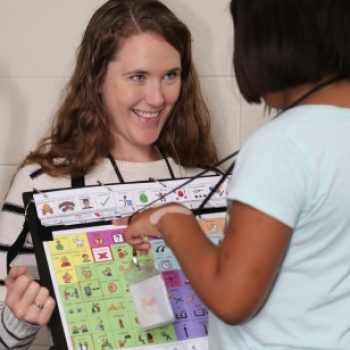
The main topic of this course was the use of the hard copy CORE board and its many possibilities.
Polly Thomas (TalkLink) explained and demonstrated the various ways that the CORE Board could be used with students who are on the Autistic Spectrum, to aid them in communication. By teachers pointing to each image they are able to communicate their directions or requests and at the same time the student is able to communicate visually.

The top of each board has a ring binder with strips of special interest words that are most relevant to the student.  Strips can be changed or added to as the child's level of communication grows.

The mantra of TalkLink for student engagement is to motivate, model and move out of the way!

The communication device can be used to communicate when on playground duty or in the classroom, or when students shut down and are unable to communicate their needs. The teacher is able to wear a 'YES' or 'NO' sign on a lanyard for those types of responses.


People

Sunday, 21 July 2019

Creating High Expectation Classrooms- Christine Rubie-Davies

Creating High Expectation Classrooms           Seminar by Christine Rubie-Davies

This seminar covered a model of teacher expectations where teachers have high expectations, plan for goal setting and mixed ability grouping, establish a positive culture of care (climate) and promote student autonomy. Some of the key findings from her research are included in this post.

Grouping can affect student motivation and learning.
Grouping can affect student motivation. A study for no streaming of Maths students.

Stereotyping can turn into bias where teachers' beliefs about  students become very fixed.
Maori students would like their teachers to be more supportive, caring, have high expectations, and help them to strive for success.

Explicit versus implicit expectations

Explicit bias asks, "Where will the students be by the end of the year?"

An implicit bias test:  Scores based on teacher hesitance in answering questions. Google search cognitive bias. The big question in the bias test was "Do Auckland teachers have implicit bias of Maori, Chinese, Pakeha?"
It was found that teachers had higher expectations of Maori and Chinese because their achievement was higher. Pakeha teachers had a strong implicit bias of Pakeha over Maori students.
There was a  20% Maths variance based on teachers and 30% Reading variance based on teachers.
Other findings from the test were that 63% of Maori were underestimated compared to 37% who were overestimated. There was almost the opposite trend for Pakeha students. Teachers were 2.2.times more likely to underestimate girls (in Math). Maori students were more oriented than Pakeha. There appeared to be a competitive stance by Maori so they had less peer support.

Rubie-Davies, C. M., Hattie, J. A. C., & Hamilton, R. J. (2006). Expecting
the best for New Zealand students: Teacher expectations and academic
outcomes. British Journal of Educational Psychology, 76, 429–444.

What has this information made me think about?  I need to...
  • Avoid  bias when setting expectations for my students.
  • Set high expectations for all of my students irrespective of race. 
  • Set higher expectations for girls than perhaps previously.
  • Know my students well through close and accurate monitoring.
  • Work on establishing sound relationships with my students.
  • The inclusion of te ao Maori is essential in my class where there is a high percentage of Maori students.
Aspects that I need to see in my classroom are...
  • Culturally responsive pedagogy and high expectation classrooms
  • Mixed ability groups
  • Positive class climate
  • Goal setting

Cultural responsiveness in the class; acknowledging the Maori world view


  • Pumanawatanga; the heart or pulse of the classroom, critical for student motivation.
  • Rangatiratanga-self managing learning
  • Nga whakapiringatanga- positive, well managed classroom
  • Ako- effective teaching and learning, teacher learning from the students, autonomy.


My class climate needs to include...
  • Whanaungatanga (relationship building), 
  • Kotahitanga (class unity and community), 
  • Manaakitanga (understanding culture and support)
Class goal setting requires...
  • Rangatiratanga; teacher monitoring feedback, autonomy, engagement,
  • Wananga-joint goal setting
  • Mana motuhake- teachers caring about student performance, clear on feedback, goal focusses, improvement focussed rather than performance, resilience and self belief.

Bringing it all together

Ministry initiatives  may have reduced explicit bias however there is still a Maori/Pakeha gap in achievement and expectation.

What's in the future?

  •  (TEP)  The Teacher Expectation Project
  • Goal setting, class climate, mixed ability

Intrinsic and Extrinsic Reward

We reflected on the types of rewards we use in our class and school and ranked them in effectiveness.
Tangible rewards significantly undermine intrinsic motivation….and we need to exercise great care.
  • Contingent reward: (conditional rewards e.g., well done, a point for you) 
  • Non-contingent: unexpected results (unconditional , thanks for waiting patiently, points for you)
Benefits of intrinsic motivation; Persistence, creativity, conceptual understanding, optimal functioning and well being.
Use student interest to engage them in activities and raise motivation.

Students need to understand what they are learning and why they are learning it, with teachers who share their progress with them.

Teachers need to give students feedback related to their goals and learning intentions as well as the success criteria (how close they have come to achieving it). teachers need to help students to set and reset goals often.

Autonomy, choice and agency requires more responsibility and monitoring.

Principles and processes of goal setting

  • Clear, specific and achievable
  • Relevant
  • Teacher has an important role
Conditions for goals to be met...


Mastery and performance goals

  • Performance goals are about the student being the best.
  • Mastery goals (of skills)  requires the teacher to focus their feedback on mastery.
  • Children like challenging goals. Importance of feedback.
  • Children need to also be help-seekers
  • Young children need close proximal goals, perhaps a week’s goal.
  • Goal setting bridges the gap between intentions and success criteria.

Implementing goal setting     Key strategies to use

  • Personal bests; self-improvement based, specific, challenging, self referenced
  • e-asTTle individual learning pathways. Have print outs for children to set goals against and share with their whanau
  • Progress chart on e-asTTle, use for reporting
  • SMART goals
  • Novice goals, change simple goals into SMART goals. 
  • Teach  students how to set goals.

What does this mean for my planning?

How will I introduce goal setting into my classroom?

  • Discussion with students about their goal setting sheets. 
  • Give feedback about how close students have come to reaching their goals and where they need to go next

Class climate 

Catherine Wentzel- Why does a student's achievement dip? Usually a dip in achievement can be linked to the level of teacher care. Engagement and climate are linked as well as mastery goals and climate.
Class relationships are important. Students reflect teacher behaviour. We are role models. Unconditional warmth is needed.
Consider the child’s world where they may have had high levels of inner turmoil,  and low self-esteem. They may have learned that anger keeps them safe and that adults cannot be trusted.
Strategies for improving the class climate are...
  • Think about the language we use
  • Separate the who from the do! Make I statements
  • Focus on the desired behaviour
  • Remember we/teachers are human too.
  • Include sport
  • Be in class before school to build relationships
  • Provide room for negotiation  and back away from pushing the point 
  • Check our non-verbal communication
  • Change groupings frequently
  • Include parents' strengths in the classroom

Traits of an effective teacher

  • High teacher efficacy
  • Teacher warmth
  • Culturally responsive teachers
Measuring the social structure in the classroom

Sociograms: Survey each child about the two children they would like in their group and one they would not like in their group.

 Sociogram website for linking the relationships in class and shedding light on how to structure the classroom.

Ideas for building a positive social structure
  • Video yourself teaching-watch non verbals
  • Listening to your students and having fun
  • Share achievements. Let them share about what they are good at
  • Sing together. Act together
  • Count kindnesses
  • Make a brag wall- each contributes.
  • Make a strengths wall: one wheel per child, filled in over time.
  • Treasure box where students put in objects or illustration of moments of pride, amusement , serenity etc
  • Special person gallery- name 3 adults who will always look after you.

Monday, 28 January 2019

Grouping and High Teacher Expectations PLD Day 29.1.19


Grouping and High Teacher Expectations  PLD Day 29.1.19


Presenter: Christine Rubie-Davies, The University of Auckland


The presentation from Christine Rubie-Davies today explained the consequences of teachers having high and low expectations of their students. Teaching practices were outlined, that could improve the self-esteem of students by steering away from purely ability groups in class. She explained that a student's self-belief is affected by teacher expectations. What the teacher values and how a teacher interacts through non-verbal and verbal signals all send a message to students about their ability.

Robert Merton was one of the first researchers to investigate the topic of self fulfilling prophecy. Bob Rosenthal was, however first to apply this concept to education (Pygmalion in the Classroom). Rats and psychologists versus teacher and children interactions, and beliefs were investigated and a framework was designed by Christine Rubie-Davies to detail how the instructional environment and the socio emotional environment (aka class climate) are influenced by several factors.


Reflective question for teachers

 How do you form expectations? What information do you use to make decisions about students?

We discussed the various ways we gather information about students such as...
  • achievement data
  • personal narratives and info
  • previous support provided, and diagnostic labelling
  • previous portfolios, reports or profiles presented
Some NZ research examined the resulting effects of teacher attitudes towards ethnicities and those students' achievement. It indicated that Maori were lower in achievement than other ethnic groups. The teacher's belief about the student's ethnicity appeared to influence the teacher's own expectations.

Reflective activity

Teachers were asked to sort the teacher behaviours into two categories, those of interactions with high achievers and those of interactions with low achievers. Teachers gave more quality time to high achievers than lower achievers. Also more wait /processing time were given to high achievers. High emotional support was given to high achievers whereas low emotional support was given to low achievers. Studies on teachers' attitudes and expectations can be influenced by bias, prejudiced and stereotypical (Babab).

It was noted by the research that, when gathering student voice,  students took note of a teacher's non-verbal language and were quick to detect insincerity, even mixed messages. They could identify the differences in how teachers responded to or treated high and low achievers. They noted that brainy students don’t get told off. 

Consequences of expectations

Two factors that influence student capability are; opportunities to learn and the extent to which mixed ability groups are used.

Lower achievers have less opportunities to learn, and less positive interactions. High achievers have more opportunities to learn,  receive positive emotional interactions, and experience challenging learning opportunities. If a student knows that a teacher likes them they will make a bigger effort. 

The way that achievement data is shared and children are grouped often forms negative self-beliefs. Teachers need to be sensitive to how this is shared as the damage can be big.

Teachers attitudes can change the learning trajectory. It was suggested that teachers video themselves teaching to analyse how they interact with high and low achievers.

 Teachers' expectations can preserve self esteem and make the pace and rate of learning easier as well as level adjustments.

Which of the high expectations are already embedded in my practice?


  • Gathering student voice about seating/grouping.
  • Learning goals based on assessment info  
  • Clear routines 
  • Extended explanations
  • Flexible groupings
  • Positive climate
  • Scaffolding
  • Use links to prior knowledge 
  • Fostering relationships
  • Give choices
  • Be positive
  • Mixed ability groups for maths word problems etc
  • Consider each students narrative.
  • High expectations for all students

Changes I am considering to my teaching

  • Multiple opportunities to learn
  • Critical thinking activities for all students
  • Check non verbal language
  • Check bias and prejudice
  • Have flexibility in groupings across subjects and focus on the learning rather than ability
  • Frequent feedback based on goals
  • Video self for observing expectations and non verbal behaviour
  •  Responsibility for learning
  • Intrinsically motivated students
  • Choice of what reader they have
  • Ways of grouping students could involve responses to topics to mix them up, perhaps a theme box e.g. frogs and related tasks on a web
  • Home reading cards with colour wheel colours, that contain differentiated instruction for parents e.g.,red books- I can read this by myself, yellow books- I can read this with some help
  • Theme box e.g.,  for shared reading higher order tasks
  • Mixed groups for some “reading activities”, pairs, task board/tumble with student choice.

Group reflection

Setting up a high expectation classroom


Wednesday, 16 January 2019

Evidence of reflective and professional practice-Term review


Term Review for Term 4 2018


The term review provides evidence of reflective practice that forms new goals for the following year. It is informed by a range of data; narrative, formative and summative.

In addition to the review I have created...

  • a Google Sheets data workbook to track student achievement over the course of the year
  • a data analysis "Quadrant" sheet that names students who require extra support
  • wedge graphs to show individual student progress in Reading, Writing and Maths
  • a Senco data tracking sheet, a Senco data analysis report, a Senco Improvement Plan and a Senco Annual report that support the students who are Tier 2 or 3 for assistance.

Monday, 29 October 2018

Reflection from Manaiakalani Staff Meeting 30.10.18

Reflection from the Manaikalani Staff Meeting 30.10.18

Reflection Questions

Do your learners know the process of learn, create, share? No

Do your parents/community know the process of learn, create, share? No

Is this visible on your school site/class site/class blog? No

What are your ‘next steps’ for 2019 to improve visibility of LEARN CREATE SHARE in your class?

  • Create a class site
  • Create a class blog
  • Teach children how to capture and share their learning, use Google Apps etc.
  • Learn the technical aspects of how MK's style of visible and rewindable learning
  • Learn how to juggle learning with shared devices

How can I, as a facilitator support you to enable visible Learn, Create, Share in your class?

  • How to set up the bones of my class site
  • Ensure my ipads/devices are set up
  • Some work around organising my images/photos to embed in site
  • Get my class blog set up
  • How to assist my one or two day a week reliever with my class site

Tuesday, 18 September 2018

Digital Fluency Intensive Reflection 19.9.18 Week 9

Digital Fluency Intensive Reflection 19.9.18

Manaiakalani Pedagogy

Ubiquitous Learning  and Rewindable Learning.

  • Anytime 
  • Anywhere
  • Any place


Rewindable learning helps this accessibility and makes it easy for learners to go back and revise their learning. For priority learners, blogs and blog comments help students to progress in literacy throughout the holidays or at least not slip back.

Rewindable learning

We reflected on one way we have scaffolded ubiquitous learning and I thought about the "old" technology of modelling books and charts of success criteria. I look forward to the new ways of  supporting rewindable learning through blogs that capture the learning and other people's comments as well as the resource links within the site. Also there will be helpful links for parents who can hook into the class resources.

Students can make tutorials by using Screencastify to share with the class. Other app.s to explore for this purpose could be ...WeVideo, pixiclip, explain everything, Movenote, Flipgrip

Opportunities for future teaching and learning

  • The COL person in the school (MK)
  • Click on the MK labels
  • Teaching as Inquiry- Manaikalani Innovative Teachers- PLD 
  • 1 hour a week with the facilitator next year
  • Tania Coutts- online facilitator- registration for Tuhi mahi tuhi atu
  • Twitter feed- hash tag based, following groups, worth discussing as a staff
  • Google + , set up a default to publish this to Google + website (see the slide deck about Google plus on minutes- What's the fuss about Google plus... share to Google plus from your blog post. Join communities (of schools and clusters).

Looking back over the eight weeks reflect on what you have learned, created and shared.

I have learned about the different Google Suite app.s and have created drawings, documents, worked within Drive, sorted bookmarks, arranged my calendar, worked with Quicktime, Screencastify, tasted ideas for robotics...

Reflect on what you know you need to focus on and gain more fluency in. Consciously decide where to get the help you need.

I will be moving into creating my Class Site fully, in preparation for next year's launch. I will be searching for resources from other Sites that will help in this construction and will be working closely with our facilitator and pilot teachers to fine-tune the Site. I need to sort out the ipads and PCs in readiness for the class Site.

Identify your strengths and what you can contribute to the wider community of learning and learners.

I feel quite confident with Sheets and Forms, Docs and Drive, blogs and playlists.


Friday, 14 September 2018

Digital Fluency Intensive Reflection Week 8 12.9.18

Digital Fluency Intensive Reflection  Week 8   12.9.18

What did I learn that increased my understanding of Manaiakalani pedagogy and kaupapa?

Empowered
The Manaiakalani pedagogy this week was "Empowered". 

Children are disadvantaged or disempowered by having less exposure to known words through less hearing and reading thus limiting vocabulary; through less formative instruction; through lack of digital technologies and connectivity; all of which can limit later life choice in real life circumstances. 

Agency is having the power or capacity to act and make choices. This ability is limited when students start school already behind in foundational skills for learning.

Manaiakalani's aim is for all students to feel at home in a digital world and in this way all students are empowered to have student voice, learner agency, and the ability to express themselves etc.

Digital technology is not just regarded as a tool, rather, it transforms the way students learn (Dean Shareski). As educators, we are encouraged to mix and match the old technologies with the new; the best of both worlds.

Kerry Boyde-Preece, from Manaikalani, explained that student learning "lives on in the blog". It has a life. It is a living artefact. She described how blogs give life to student talents that may not have normally been promoted within the school curriculum. Students are empowered by knowing how to blog and put their work out to the world. They receive feedback and comments that add to that feeling of being empowered and links them with others with a similar talent.

Newly created jobs, such as drone operators are made possible through cutting edge digital knowledge. Students who have developed knowledge in this area have far more opportunities for employment. 

For Manaiakalani, the default is being visible. Kerry says that you can't truly be empowered  without being visible, connected, and ubiquitous, i.e.,work any time you choose and on a global stage.

We were challenged to reflect on how each has been empowered by Manaiakalani.
Professionally, I have been empowered with the increase in teaching knowledge. I have learned many new skills that I can share with my students, to help them learn, create and share.


What did I learn that could increase my confidence, capability or workflow as a professional?

Tania Coutts spoke on the key topic of Computational Thinking which is part of the New Zealand Technology Curriculum/Hangarau- Matihiko (Maori medium).

"The new content has been designed to be flexible, so it can respond to new developments and technologies as they emerge". Nicki Kaye, June 2017
New acronyms to be aware of in the curriculum are...
CT4DT- Computational Thinking for Digital Technologies
3DO- Designing and Developing Digital Outcomes

Kia takatu a Matihiko- The Digital Readiness Facebook page-https://www.facebook.com/kiatakatu/


Pikau/ Toolkits on the above page provide courses that are a good place for teachers to understand the new curriculum.

This an excellent video is about "What most schools don't teach".
https://www.youtube.com/watch?v=nKIu9yen5nc   

Also, a nifty little poster about 'Ten reasons to teach coding'...

What did I learn that could be used with my learners?

Most of the app.s we played with will be shared with our students. I worked with Robyn on the green screen video. This was very new to us so we were reliant on the instruction of our patient tutors to create a short green screen video with a background. I took an image of the trees outside and part of the waka shelter on the Waitangi grounds as the background. To this Robin added her ScuptGL image and Blake's video. The background noise was split out. 


Sculpt GL
I had a limited play with this app. with the resulting rather clunky image of DFI. 

 Block Coding-Robots: This app. was great for helping students construct a sequence of steps for the robot to follow. 

Clapmotion: I observed others telling a story with this app. and Lego figures.

I would like to explore more of Tinkercad, Do ink, Tilt Brish, and Paint3.

What did I learn that could be used to increase my confidence, capability and my workflow in my personal life?

I was reminded of how wonderful iMovie is for creating movies and slide shows and the work with a green screen took this knowledge to a new level. It was great to play and explore with new technologies and the opportunity builds my confidence eventually.