Saturday, 30 January 2021

Manaiakalani Symposium for Teachers at Waitangi

 Manaiakalani Symposium for Teachers at Waitangi 28.1.21

I attended 4 workshops at Waitangi.

First, teachers could visit the 2 museums at Waitangi which, I think, every New Zealander should visit at least once. I also think every school child in the mid to far North of NZ should visit the museum as part of their education about the history of NZ. This is a very informative venue and very professionally presented.


Next was Physical Computing: Bringing coding out of the screen and back into the real world with micro:bits presented by Monika Kern.  https://makecode.microbit.org/  We explored microbits, small LED screen that can display a coded message, programmed by a student or adult. Photos below show the screen and computer set up for this Microsoft programme. My Apple computer did not respond well to this product until I verified my access.

Monika introduced us to simple circuits by Makerspacers. These fun and practical circuit lessons would be well received by my students!


Creativity in 3D 

Next I attended the Tinkercad workshop presented by CJ Serfontein


Tinkercad is a free, online 3D modeling program that runs in a web browser, known for its simplicity and ease of use. It's used by teachers, kids, hobbyists, and designers to imagine, design, and make anything! Tinkercad by Autodesk provides an easy, early training ground to introduce students to the world of 3D design and exploration.


The final workshop about movie making was presented by Harley Alexander. This session explained the composition of a movie. I found it to be a good reminder of the gear needed for movie making too. His presentation is below.

https://docs.google.com/presentation/d/1UX8vLo-mFeGyLrRtR1Ow8_RppjiuJqThq7JT1tSX7Ko/edit?usp=sharing 

Tuesday, 20 October 2020

Making Sense of Sensory Strategies - Professional learning

Making Sense of Sensory Strategies - Professional Learning


Professional Learning courtesy of Ministry of Education, Learning Support

Keynote Speakers:

Bohdan Pasternak (OT), Jennet Penney (OT), Beverley Jackson (SLT)


The main aim of this course was to promote wellness for neurodiverse learners.

Stuart Shankers outlines 3 key steps when teaching children with challenging behaviours.

  1. Find stressors  then reduce them

  2. Find unmet needs then meet them

  3. Find skill deficits then teach them


Internal sensors

  • Vestibular

  • Proprioception

  • Interoception


Vestibular:

Alerting- Spinning, swinging, inversion

Calming- rhythmic rocket, swinging, predictable movements


Fine Motor activities:

Puzzles, cutting time, paint, draw, buttons, zips, laces, dress ups


Gross motor:

Outside play, negotiate surfaces, develop balance, skateboards, trampoline, spinning, hanging upside down.

Core strength activities: Wheelbarrow walking, gym ball walk over.

Sensory Integrative Dysfunction or SPD signs

  • Avoidance

  • Seeking

  • Over arousal

  • Under arousal

Consider a child’s Maslow’s hierarchy of needs.


It is important for teachers to manage their own reaction and not become heightened.


The choice of sensory tools is influenced by…

  • The goal or purpose

  • The person

  • The likes and dislikes

Adapt the environment for each child’s needs.


As a teacher and SENCO this course has encouraged me to purchase a variety of fidget spinners and play things and weighted blankets to use in the classroom. Also our kit needs to include balance boards, gym ball, fine motor games and possibly a trampoline.

Additional pdf from today:


https://drive.google.com/file/d/1JKugo_06YvYn8sseBbk-BZrbyLo1taBV/view?usp=sharing

https://drive.google.com/file/d/1hTDmkrI-TdUjKrl2DaJ1mbf5W8IbBekT/view?usp=sharing

https://drive.google.com/file/d/1quv9iOikrcy1BYa0O68LBuU24hKuBEEt/view?usp=sharing

https://drive.google.com/file/d/1PoG8ox657CXGOHmmMMrztETT_fJx6LsN/view?usp=sharing

https://drive.google.com/file/d/1OINfpLpqFdhMDX7WcX_zdljZA9sIVS50/view?usp=sharing


Saturday, 10 October 2020

A book review of Glow Kids by Dr. Nicholas Kardaras

 Glow Kids by Dr. Nicholas Kadaras, Ph.D.

Professional Reading


In this book Kadaras draws our attention to a growing problem...the addiction many children, youths and adults  are developing to digital media. As children have thinner skulls and scalps to adults and their brain neurons are still developing, he believes that children should have limited or even no exposure to the highly influential computer games currently on the market. He states that education in the States enabled a lot of children to have extra time online, exacerbating the problem of addiction. He believes education should foster the arts, the outdoors, structured play (e.g., lego), human interaction, handwritten stories,  discussion, learning in reading, writing and maths and critical thinking. Children should be taught how to think before computers are introduced to the equation even waiting for children to reach the age of 10. Even the engineers from Apple and Google, he claims, send their children to no-tech schools!


According to Kadaras there are newly defined syndromes emerging from the prolonged exposure to game technology that is deliberately designed to pump up the adrenaline and dopamine levels of the players so that they prolong their engagement. Dangerous levels of these two substances can lead to children losing touch with reality and becoming hyper stimulated.  Humans are not able to process sustained levels of these, i.e., for more than an hour, let alone sessions of 10+ hours.  Children  confuse reality with the game they have been playing, often hearing and seeing characters or patterns/images/sounds from that game when they are no longer playing it. The games can erode their self esteem and create paranoia that, at the worst level, make children susceptible to going on a shooting rampage and at the lowest level manifest as an inability to regulate their emotions and aggression, causing problems within school and their family. Radiation from prolonged digital use can affect the brain itself and potentially give rise to brain tumors and cancer.


Syndromes related to the upsurge of digital time are the likes of ADHD which has increased by 800% in the last 10 years, and the inability to focus on non-digital work,  A kid’s brain on tech looks like a brain on  drugs. There is Internet Addiction Disorder (IAD), and Game Transfer Phenomena (GTP) where reality and the game are confused. Dr Victoria Dunkley researched whether the many behaviours that are on the increase shared the same underlying condition, that of hyper stimulation. She researched ODD, depression, ADHD, sleep disorders, mood disorders, aggression, even autism. The common denominator for what these children had been exposed to between 1994 to 2003 was screens. 


One solution for addiction that Kadaras suggests, is for the child to undergo a digital fast. Here the child is gradually weaned off device time by an hour a day until there is abstinence for 3 further weeks, where device time is carefully reintroduced with tight parameters. He suggests that they should not go cold turkey unless the parents are prepared for rage to be unleashed on the home. He says parents should be able to  refuse the use of tech for their child at school. Studies in America showed that after hundreds of millions of dollars had been spent on the 1-1 device programmes that children found plenty of loopholes to access porn and blocked games, so much so that these device programmes were ceased in favour of quality teacher time. 


In addition, this book also lays out the ways in which the economic interests of the tech industry are often at odds with the needs of our children and the growing mountain of findings from research. The start of the 1-1 device programmes in the states was not well researched and was given over to companies that employed 20 somethings to design dopamine pumping “educational” games to replace quality teaching. It became a money making endeavour that made a lot of executives very rich but did little to assist the education of children. 


I found the chapters on how education has been influenced by digital companies and misguided writers of curriculum, very interesting  as I teach in a 1-1 environment. The research from Dr Vallance in Australia, found that the introduction of laptops and tablets  into classrooms has led to less rigor in the classroom and have taken away from teacher preparation, indicating that laptops “ introduced a great deal of slackness” in teaching and “ made it much easier of giving the illusion of having prepared a lesson.” I have wondered throughout this year why some students, in particular boys,  display such high levels of aggression and an inability to regulate their emotions. After reading this book, I can identify several boys who “act out” their games and actively seek them out  even during class time, looking for loopholes to feed their interest and use tech contrary to the school’s guidelines. These boys become very verbally aggressive and angry with each other and oppositional when redirected to other activities. Their focus drifts to the images playing on the class TV screen, interrupting lessons to comment loudly on the images. Their drawings are of game characters, often hideous troll looking characters.


As a result of reading this book I will survey my students gaming habits and think carefully about how often they are online. I will be explicit about what is to be achieved in a short space of time as they use Google apps.  I will prefer hard copy reading as it is espoused to enable children to analyse text better and will introduce more discussion, arts and construction time as well as keeping the TV screen off until it is needed as a tool.


Wednesday, 28 August 2019

Cheryl Torrie- Blinging Blogs with Images


Cheryl Torrie- Blinging Blogs with Images- Teacher Professional Development

Cheryl presented a great slide show that demonstrated how to create collages of photos to embed in our blog posts. These collages could replace the long 'scroll-down' photos of the novice blogger, namely me.

She gave a variety of apps and websites for this purpose.

To demonstrate my fledgling understanding of this I have embedded one of my own collages using random photos (from various Science lessons) that were stored in Google Photos.


Lunapic was one app. that created artistic effects from photos. I have attempted an example of this here with a shot of my siblings and me.


Monday, 26 August 2019

Marc Gibson - T3 - Using flexible learning groups within the curriculum

Marc Gibson -Using Flexible Learning Groups Within the Curriculum


As part of our digital professional learning, Marc Gibson presented the way his school worked with 75 students in a class of 3 teachers. Students worked in flexible groupings that sprang out of the workshops and the roles of teacher as "Taskmaster" and "Coach". Learners select workshops based on their learning needs (taken from the Literacy and Maths Learning Progressions).

The systems within the class were well unpacked with students in term 1 of the year, timetabling was changed each week and a method for students to upload their work to a Learning Progression was established. Students select and sign up to at least 1-2 workshops in each subject area on Monday with the help of a teacher.

Teachers have a different role each week over a three week period.  In Reading the coach works on the end goal  and students work on one task for the whole week, a task that fits with any book. A set of 8 texts is selected each week. Students click on the title to see other complimentary reading and challenging reading related to the book. This meets the requirements for "Multimodal" learning. Students do not work in ability groups although the lower readers do work together but are still part of the book choices for homework etc.

The class site is shared with parents so they can see what the book choices  and tasks.

In writing the students have to complete one piece of writing for the week. During this time the ESOL students leave the room.

In Maths there is a Hotspot activity in the main learning area e.g., fractions. The teachers work in three roles as coach, problem solving and workshops. There is also a Heart zones activity which is more like play based learning. The workshops plug the gaps in the knowledge. Each students has to complete one artefact to show they have learned it. For problem solving teachers work with groups of 18, on 2 problems a week. The students have a specific process to work through.

Each child has their own digital copy of the progressions that are highlighted once they have proven that they have learned it. From these progressions the teachers can target the learning and address the gaps.

So what does this mean for my teaching?

It took much time to set up this school's systems.  They now have a cohesive mode of teaching and learning that meets students' needs, motivates students and raises ability.
Of course this new system needs to be from the top down in a school setting such as ours. School management needs to engage with the process and not see it as a quick fix strategy. It requires commitment over time.

I could...
  • Trial the workshop idea on my class site and have a variety of reading books for the book choice. This would work more for my readers who are achieving at a good standard
  • For my underachievers daily guided reading and mileage is worth continuing and their workshops would be based around their need for decoding and alphabet skills. Their voice needs to be factored in to the planning
  • Process writing would continue along with choices for some different genre or types of grammar. Nothing is new there.
  • Problem solving options help create mixed ability groupings and sound better when students mix themselves for maths through their choices (rather than the predetermined mixed groupings that I have heard other educators talk about)
  • Workshops that plug the gaps in student knowledge also sound worth doing. 
There is only one teacher in my class of 26, so this limits the flexible nature of groupings and options. However, it would be good to include a few of these ideas in the planning  as part of my own inquiry.


Wednesday, 31 July 2019

Professional Development for Educators of Children with Additional Needs (SENCO)

Educators of Children with Additional Needs 

The Hub

Tony Hassan from Learning Support, Kaitaia spoke to the seminar. There has been recent consultation in the Far North around the Ministry of Education's Learning Support Hub and in particular the co-designing of the Learning Support service delivery in Tai Tokerau.  The Hub in the Hokianga Initiative is promoted online with the dates the team of RTLBs and MoE's Learning Support will be visiting the schools of the area. The Hub is made up of  the Ministry of Education agencies such as speech language, oral language help, and early intervention etc. Parents/ whanau can call into the Hub to seek help for their child or attend sessions that assist the child such as speech training. Tony said the rate of new referrals had increased 1400% since the commencement of the Hub. The most referral cases have been for communication. Future additions to the Hub may be the inclusion of health services.

Learning Support Action Plan

Priorities for action
1. Learning Support Co-ordinators
2. Screening and early identification of learning support needs
3. Strengthening early intervention
4. Flexible supports for neurodiverse children and young people
5. Meeting the learning needs of gifted children and young people
6. Improving education for children and young people at risk of disengaging


Mindfulness from an Indigenous Perspective      Joni Gordon

Joni's PHD study hypothesis: Do the spiritual practices of Kura Kaupapa have a mindfulness effect?

Conceptualising Maori mindfulness: the tensions and opportunities when reconciling mindfulness.and kaupapa Moari
Matauranga Maori and Mindfulness
  • Whakapapa-genealogy
  • Nga Atua Maori-The pantheon of Maori godds
  • Spiritual practices: karakia (prayer), tohi , takutaku (chants)
  • Environment
  • Manawa/ Mauri- negotiating their interaction
Influences:
  • European ethnographers
  • Literature, veers towards the male lens
  • Mana wahine-reclamation of ancient wisdom and making space
  • The politics of indignity
Be present
  • Ritual time
  • The collapsing of time into space
  • Time in relation to environment
  • Reading the stars
Mauritau/ Manawaora- how these concepts interact
Reconciling heart and mind

Examples of mindfulness practices:
Deeply considering a taonga.
Deeply reflecting on a poem etc in Maori and English (and sharing what was experienced ) 

Massey University have an online collaborative network, the"Learning Support Network".        Mandia Mentis (Massey)

This website consists of

  • A wealth of resources for the special education teaching community, in particular for SENCos
  • Networking and connecting of SENCos nationwide through calendars of events
  • Live webinar every Thursday evening
  • Online professional development modules to complete for teachers
  • Digital badges can be earned that can cross credit to a short course, a Post Graduate Qualification into Learning Support
  • Helps SENCos integrate their learning into our practice
  • Alignment with the 6 teacher standards
  • Supports SENCo inquiry

So what did today's seminar mean for my role as SENCo?

  • Connect to the Learning Support Network website with one other person in the school
  • Participate in weekly webinars online as often as possible, to gain digital badges towards a Post Graduate in Learning Support
  • Incorporate mindfulness practices into my class (in a way that aligns with who I am) as well as  for high anxiety students
  • Investigate the new Learning Support  Coordinator role and Action Plan.


Wednesday, 24 July 2019

Talk Link Course a Professional Development Course for Special Education Teachers

TalkLink, a Professional Learning Opportunity for Teachers 


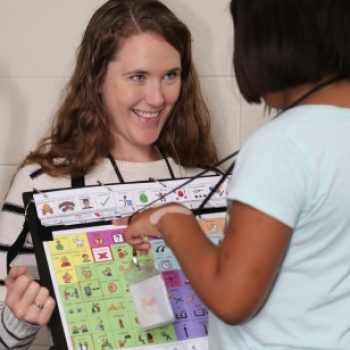
The main topic of this course was the use of the hard copy CORE board and its many possibilities.
Polly Thomas (TalkLink) explained and demonstrated the various ways that the CORE Board could be used with students who are on the Autistic Spectrum, to aid them in communication. By teachers pointing to each image they are able to communicate their directions or requests and at the same time the student is able to communicate visually.

The top of each board has a ring binder with strips of special interest words that are most relevant to the student.  Strips can be changed or added to as the child's level of communication grows.

The mantra of TalkLink for student engagement is to motivate, model and move out of the way!

The communication device can be used to communicate when on playground duty or in the classroom, or when students shut down and are unable to communicate their needs. The teacher is able to wear a 'YES' or 'NO' sign on a lanyard for those types of responses.


People